Resources
South Florida Condo Financing Report, Q3 2026
Short answer
The median condo or townhouse sold for $409,500 in Miami-Dade, $250,000 in Broward and $307,500 in Palm Beach in the third quarter of 2026, and 53% of the 8,059 closed sales across the three counties were paid in cash, per MIAMI REALTORS data retrieved in November 2026. The rules changed too: Fannie Mae deleted the Limited Review path for condo loans in August 2026, and Florida now requires milestone inspections and a structural integrity reserve study (SIRS) for buildings three habitable stories or higher. For a buyer, that means the building's paperwork decides which loans are possible before your credit does.
| Market | Condo median price (Q3 2026) | YoY | Closed sales | Cash sales share | Months of supply |
|---|---|---|---|---|---|
| Miami-Dade County | $409,500 | -0.1% | 2,846 | 49.1% | 12.3 |
| Broward County | $250,000 | -4.9% | 2,752 | 52.1% | 10.2 |
| Palm Beach County | $307,500 | +3.3% | 2,461 | 58.5% | 6.8 |
| City of Miami | $555,000 | -4.3% | 582 | 53.8% | 16.8 |
| Miami Beach | $495,000 | +2.1% | 330 | 68.5% | 12.7 |
| Sunny Isles Beach | $650,000 | -6.5% | 162 | 72.8% | 18.9 |
| Aventura | $445,000 | -6.2% | 196 | 71.4% | 16.8 |
| Fort Lauderdale | $500,000 | +23.5% | 347 | 58.5% | 10.5 |
| Boca Raton | $569,000 | +45.9% | 171 | 66.7% | 7.4 |
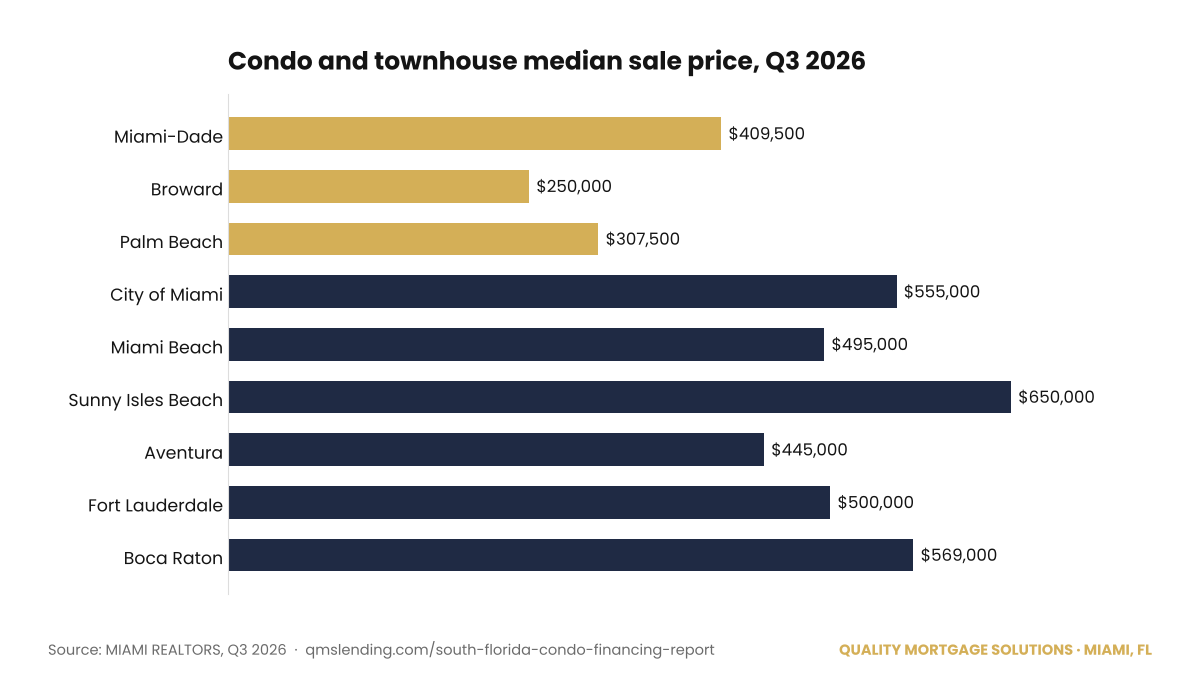
The numbers: prices, sales, cash and supply, Q3 2026
Condo and townhouse prices held in Miami-Dade and Palm Beach and fell in Broward in the third quarter of 2026, per MIAMI REALTORS quarterly reports released October 16, 2026 and retrieved in November 2026. The Miami-Dade median was $409,500 (down 0.1% from $410,000 a year earlier) on 2,846 closed sales (up 4.3%). Broward's median was $250,000 (down 4.9%) on 2,752 sales (down 8.1%). Palm Beach's median was $307,500 (up 3.3%) on 2,461 sales (up 2.2%).
Cash is the other half of the market. Of 8,059 closed condo and townhouse sales in the three counties, 4,270 were paid in cash, or 53%. The share was 49.1% in Miami-Dade (1,396 of 2,846), 52.1% in Broward (1,435 of 2,752) and 58.5% in Palm Beach (1,439 of 2,461). In the coastal condo cities it ran higher: 72.8% in Sunny Isles Beach, 71.4% in Aventura, 68.5% in Miami Beach and 66.7% in Boca Raton.
A cash share above 50% tells you two things. Many buyers are investors, second-home owners or foreign nationals who prefer cash. And in some buildings a mortgage is hard to get, so cash buyers set the price. When a building cannot be financed with a conventional loan, the pool of buyers shrinks to cash and to specialty lending.
Supply is still heavy but shrinking. Months of supply fell in every county: 12.3 months in Miami-Dade (from 14.0), 10.2 in Broward (from 11.6) and 6.8 in Palm Beach (from 8.8). Active condo inventory was 11,706 units in Miami-Dade, 9,582 in Broward and 5,858 in Palm Beach. The City of Miami carried 16.8 months of supply and Sunny Isles Beach 18.9.
City medians ranged from $445,000 in Aventura to $650,000 in Sunny Isles Beach. The City of Miami median was $555,000 (down 4.3%) on 582 sales, with an average price of $996,460. Fort Lauderdale (up 23.5%) and Boca Raton (up 45.9%) posted big jumps on small samples (347 and 171 sales), so read those two with care.
The rules that decide whether a building can be financed
Milestone inspection (Florida Statutes 553.899). Condo and co-op buildings three or more habitable stories tall need a structural milestone inspection by December 31 of the year the building turns 30, counted from its certificate of occupancy, then every 10 years. The local building department may set the first deadline at 25 years for local conditions such as proximity to salt water. Phase one is a visual inspection by a licensed engineer or architect; if it finds substantial structural deterioration, a phase two with testing follows. The association must send the inspector's summary to every owner within 45 days and post it.
Structural integrity reserve study, SIRS (Florida Statutes 718.112(2)(g)). The same buildings need a SIRS at least every 10 years covering roof, structure, fireproofing, plumbing, electrical, waterproofing and exterior painting, windows and exterior doors, and any other item with a replacement cost over $25,000. Associations that existed on July 1, 2022 had to finish the first study by December 31, 2025 (House Bill 913, chapter 2025-175, moved it from December 31, 2024), and in no event after December 31, 2026. For budgets adopted on or after December 31, 2024, owners can no longer vote to waive or reduce the reserves the SIRS calls for. HB 913 added relief: after a milestone inspection, a majority of owners may pause or reduce SIRS reserve contributions for up to two consecutive annual budgets (through budgets adopted by December 31, 2028), reserves may be funded with a loan or line of credit, and reserve money may be invested in bank CDs or deposits without an owner vote.
Fannie Mae, SEL-2026-07 (August 5, 2026). The Limited Review for established condo projects was deleted from the Selling Guide; only loans with an application date before August 3, 2026 can still use it. The Florida-specific section ("Geographic-Specific Condo Project Considerations") was deleted too, after Lender Letter LL-2026-03 (March 18, 2026) retired the mandatory PERS review for new attached-unit condo projects in Florida and the investor concentration limits. Review paths today are the Full Review, PERS, or a waiver of project review where one applies. New reserve standards enter the Selling Guide after January 4, 2027.
Fannie Mae, B4-2.1-03 Ineligible Projects (updated November 4, 2026). A project that needs critical repairs is ineligible. Any unfunded repair costing more than $10,000 per unit that should be done within the next 12 months counts as critical. A special assessment tied to a critical repair that has not been fixed makes the project ineligible. If a structural or mechanical inspection was completed within 3 years of the lender's review date, the lender must read it, and it cannot show open critical repairs or an evacuation order. Projects run as a hotel, with more than 35% commercial space, or in litigation over structural soundness are also ineligible. B7-3-03 requires the master policy to cover 100% of replacement cost, windstorm (including named storms) included, with deductibles no higher than 5%.
FHA. An FHA condo loan needs a project on HUD's approved condominium list, or a unit that qualifies for Single-Unit Approval: a completed project with at least five units, not manufactured housing, and FHA concentration of no more than 10% in projects of ten or more units. The lookup is at HUD's condominium search.
Flood (Citizens). Citizens Property Insurance requires flood coverage on personal residential policies with wind coverage, phased in by dwelling value ($600,000 in 2024, $500,000 in 2025, $400,000 in 2026, all policies on January 1, 2027). Condominium unit-owner policies are exempt, so the rule hits houses and townhomes insured by Citizens, not HO-6 condo policies. All figures as of November 2026.
What gets financed in 2026
Warrantable buildings. A warrantable condo passes a Full Review or PERS: no critical repairs, no open structural special assessments, budget and reserves in order, insurance that meets B7-3-03, and owner-occupancy, commercial space and single-owner concentration within limits. These units may qualify for conventional loans, jumbo loans above the conforming limit, FHA loans when the project is on HUD's list or gets single-unit approval, and VA loans in VA-approved projects. Low down payment options exist on conventional and FHA, subject to credit approval.
Non-warrantable buildings. A non-warrantable condo fails one of those tests: a pending milestone phase two, an unfunded structural repair, a special assessment for concrete work, a lawsuit about the structure, too much commercial space, or one investor holding too many units. Conventional, FHA and VA loans are off the table, but non-warrantable condo loans from portfolio and non-QM programs can still work, usually with a larger down payment and a closer look at the building's repair plan. Full details in our non-warrantable condo financing guide.
Condotels. A building run like a hotel, with a front desk, short-term rental program or mandatory rental pool, is ineligible for Fannie Mae and FHA no matter how good its structure is. Condotel loans are specialty programs with their own down payment and reserve rules; see what a condotel is.
Investors. For a unit you will rent out, a DSCR loan qualifies on the unit's rent instead of your tax returns. DSCR, hard money and commercial loans are business-purpose loans and do not follow the same consumer rules. Some DSCR programs accept non-warrantable buildings.
Quality Mortgage Solutions is an independent mortgage broker in Miami, FL. We shop more than 100 wholesale lenders, so when one program says no to a building we look for the next one. We do not quote rates here; rates vary daily and by borrower. Every program is subject to credit approval. Equal Housing Opportunity.
Reading a building's paperwork before your inspection period ends
Ask for these documents the day your offer is accepted. Your inspection period is short, and the building, not the unit, is what a lender underwrites.
- Condo questionnaire: the lender's form the association fills out. It asks about owner-occupancy, delinquencies, litigation, commercial space, special assessments and repairs. Ask the seller to order it early.
- Milestone inspection report and summary: for buildings 30 years old (or 25 in some coastal jurisdictions). Look for the phase one result, whether phase two was required, and the repair list. Any report within the last 3 years must be read by the lender.
- SIRS: the reserve study and its funding plan. Compare the required annual reserve contribution to the current budget. A gap means higher dues, a special assessment or a loan ahead.
- Budget, year-end financials and reserve balances: confirm reserves are funded as the SIRS requires and check how many owners are delinquent.
- Special assessments: amount per unit, purpose, what remains unpaid, and the payoff date. One tied to an unfixed critical repair makes the building ineligible for Fannie Mae.
- Master insurance policy: 100% replacement cost, windstorm included, deductible of 5% or less. If it does not cover unit interiors you need an HO-6 policy.
- Estoppel certificate: the association's statement of what the unit owes, due within 10 business days of the request. Florida law caps the fee at $250, plus $100 for rush delivery and $150 more if the account is delinquent, adjusted for inflation every five years by the DBPR; the adjusted caps are $299, $119 and $179 as of November 2026.
A bilingual loan officer at 305-425-1990 can review the package with you before the contingency deadline.
What it means for sellers, buyers and agents
Sellers
- Order the condo questionnaire, milestone summary, SIRS and budget before you list. A building that can be financed sells to the 41% to 51% of county buyers who use a mortgage, not only to cash.
- If the building is non-warrantable, say so in the listing and price it for the financing that exists. A surprise on day 20 of a contract costs more than honesty on day 1.
- In Sunny Isles Beach, Aventura and the City of Miami, 16.8 to 18.9 months of supply means your buyer has choices. Clean paperwork wins.
Buyers
- Get the building reviewed before you fall in love with the unit. A lender can read the questionnaire and milestone report in days.
- Budget for the association, not just the mortgage: SIRS reserves can no longer be waived in most buildings, so dues now reflect the real cost of the structure.
- If a conventional loan fails on the building, a non-warrantable program may still qualify with a larger down payment. Ask before you walk.
Agents
- Put the milestone and SIRS status in your MLS remarks. The lender will ask anyway.
- Treat an open structural special assessment as a financing problem, not a negotiation point. If it is tied to a critical repair, Fannie Mae will not take the loan until the repair is done and documented.
- Keep a broker who can place non-warrantable, condotel and DSCR loans on speed dial. About half of South Florida condo sales are cash; the other half need a lender that will accept the building.
Method, sources and how to cite
Cite this data as: Quality Mortgage Solutions, South Florida Condo Financing Report, Q3 2026, https://qmslending.com/south-florida-condo-financing-report. Reporters and partners may reuse the table and chart with a link to this page.
- Market data: MIAMI REALTORS / Florida REALTORS Quarterly Market Summary, Q3 2026, Townhouses and Condos, for Miami-Dade, Broward and Palm Beach, and the Q3 2026 Local Residential Market Metrics by city. Released October 16, 2026; retrieved November 2026. "Cash sales share" is closed sales paid in cash divided by closed sales, our calculation from the reported counts. City rows follow the report's municipal boundaries; Brickell is part of the City of Miami.
- Rules: Florida Statutes 553.899, 718.112 and 718.116 (2025), the Florida Senate summary of CS/CS/HB 913 (2025), Fannie Mae SEL-2026-07, LL-2026-03 and Selling Guide B4-2.1-01, B4-2.1-03 and B7-3-03, HUD's FHA condominium lookup, Citizens Property Insurance flood requirements, and the Florida Realtors estoppel fee page. All retrieved November 2026.
- Not included: rates, ZIP-level data, co-ops, and any figure we could not read directly from a published source.
Refresh: quarterly. Next edition: Q4 2026, in February 2027. Data by Quality Mortgage Solutions, Miami, FL, NMLS #1781090. Equal Housing Opportunity.
Sources
- MIAMI REALTORS, South Florida Market Stats, Q3 2026 (report index)
- Florida REALTORS Quarterly Market Summary Q3 2026, Miami-Dade County, Townhouses and Condos
- Florida REALTORS Quarterly Market Summary Q3 2026, Broward County, Townhouses and Condos
- Florida REALTORS Quarterly Market Summary Q3 2026, Palm Beach County, Townhouses and Condos
- Q3 2026 Local Residential Market Metrics by City, Miami-Dade, Townhouses and Condos
- Q3 2026 Local Residential Market Metrics by City, Broward, Townhouses and Condos
- Q3 2026 Local Residential Market Metrics by City, Palm Beach, Townhouses and Condos
- Florida Statutes 553.899, Mandatory structural inspections for condominium and cooperative buildings (2025)
- Florida Statutes 718.112, Bylaws (SIRS and reserves, (2)(f) and (2)(g))
- Florida Senate, bill summary CS/CS/HB 913 (2025), Condominium and Cooperative Associations
- Florida Senate, CS/CS/HB 913 (2025) bill page (chapter 2025-175)
- Fannie Mae Selling Guide Announcement SEL-2026-07 (Aug. 5, 2026)
- Fannie Mae Lender Letter LL-2026-03, Updates to Project Standards and Property Insurance Requirements (Mar. 18, 2026)
- Fannie Mae, In Case You Missed It: 2026 Selling Guide and Servicing Guide policy updates
- Fannie Mae Selling Guide B4-2.1-01, General Information on Project Standards
- Fannie Mae Selling Guide B4-2.1-03, Ineligible Projects
- Fannie Mae Selling Guide B7-3-03, Master Property Insurance Requirements for Project Developments
- HUD, FHA Approved Condominiums lookup
- HUD, Condominiums help (Single-Unit Approval criteria)
- Citizens Property Insurance, Flood coverage requirements
- Florida Statutes 718.116(8), Estoppel certificates
- Florida Realtors, Information on Estoppel Letters/Certificates (adjusted fee caps)
Educational content, not a commitment to lend. Figures are from the sources listed and were accurate when reviewed; programs, limits and rates change. All loans subject to credit approval.
How to cite this data
Free to use with attribution. Cite as: Quality Mortgage Solutions, "South Florida Condo Financing Report, Q3 2026", November 17, 2026, https://qmslending.com/south-florida-condo-financing-report. Link back to this page when you publish it; a link lets readers check the numbers and sources. Refreshed quarterly.
Loan programs that fit
Related reading
FAQ
Questions about South Florida Condo Financing Report, Q3 2026
Don't see yours? Call us or send a message. We answer the same business day.
305-425-1990Can I still get a conventional loan on a Miami condo in 2026?
Yes, if the building passes a Fannie Mae Full Review or PERS: no critical repairs, no special assessment tied to an unfixed structural problem, reserves and insurance in order. The shortcut Limited Review ended for applications dated August 3, 2026 or later, so the lender now reads the full package on every condo. Subject to credit approval.
What happens if the building failed or has not done its milestone inspection?
A missing inspection on a building that is past its deadline, or a phase two finding with unfunded repairs over $10,000 per unit due within 12 months, makes the project ineligible for Fannie Mae. FHA and VA will also usually decline. Non-warrantable condo programs may still finance the unit with a larger down payment while the repairs are planned or under way.
Why are so many Miami condo sales cash?
In Q3 2026, 49.1% of Miami-Dade condo and townhouse sales were cash, and over 70% in Sunny Isles Beach and Aventura. Part of it is who buys here: investors, second-home owners and foreign nationals. Part of it is that older buildings with open repairs cannot be financed with conventional loans, so cash buyers set the price there.
What is a non-warrantable condo loan?
A loan from a portfolio or non-QM program for a unit in a building that does not meet Fannie Mae, Freddie Mac or FHA project rules: pending structural repairs, litigation, high commercial or investor share, or hotel-style operation. Expect a larger down payment, full documentation on the building, and no rate quote until the building is reviewed. See our [non-warrantable condo guide](non-warrantable-condo-financing-florida).
Do I need flood insurance or an elevation certificate for a condo?
For a unit in a multi-story building, flood coverage is normally carried by the association's master policy when the building sits in a Special Flood Hazard Area, and your lender will ask for proof of it; an [elevation certificate](what-is-an-elevation-certificate) is rarely needed for the unit itself. Citizens' phased-in flood mandate exempts condo unit-owner policies. Townhouses with their own policy are treated like houses.
How much is a Florida estoppel certificate?
Florida Statutes 718.116(8) caps the fee at $250, plus $100 for delivery within 3 business days and up to $150 more if the unit is delinquent, with the DBPR adjusting the caps for inflation every five years; the adjusted caps are $299, $119 and $179 as of November 2026. The association must deliver it within 10 business days or charge nothing.
Get started
Know your numbers before you make an offer.
Get a quote in minutes, or call and talk with a licensed loan officer today.